Monday, December 19, 2016

Illegal & Unethical


QUESTION:
Our association recently recovered funds from a lawsuit which the homeowners were charged a special assessment. The board opted to place the funds in the reserve account rather than reimburse the homeowners for their payments. Is this ethical or legal?
ANSWER: Unless the board promised to reimburse owners or somehow made it a condition of the special assessment, it is neither illegal nor unethical to put the money in the reserve account.
Reserve Funding. In fact, not doing so may be imprudent if your reserves are badly underfunded. Failing to fund the reserve account now could result in special assessments later when large repairs are needed and reserves are insufficient. Then everyone would rail against the board for not funding the reserves.
Who Gets the Money? Also, for those units sold after the special assessment but before the recovery, who gets the money? Does it go to the ones who paid it but no longer have a legal interest in the association or the ones who bought units and lay claim to the reimbursement? That could get messy.
RECOMMENDATION: Prudent fiscal management is one of the duties of the board. If you disagree with how they are handling the association’s money, you should consider running for the board.

Wednesday, December 14, 2016

Seating Arrangement


QUESTION: Is there a seating protocol for board members on the dais? Is it appropriate for the manager and attorney to be seated on the dais? What is common practice?
ANSWER: There is no seating protocol that I’m aware of. I checked Robert’s Rules of Order and found nothing on the subject.
Seating Arrangements. I’ve been in meetings where the board, manager and attorney were (i) on an elevated dais with everyone facing the audience, (ii) seated at tables in a “u” shape (common with larger boards), (iii) seated at a round table with the backs of some directors to the audience, (iv)  seated randomly in comfy chairs in someone’s living room, and (v) seated in folding chairs on one side of a pool and the audience on the other side (a quasi separation of church and state–if you could walk on water, you could join the board). My favorite is where the board met in the alley next to a dumpster and everyone stood (it made for very short meetings).
On A Dais. When the board meets on a dais facing the audience, the most common position for the manager and attorney is at the end of the table. The second most common is for the attorney to be seated next to the president so he/she can consult with the attorney as-needed during the course of the meeting.

RECOMMENDATION: Generally, the larger the association, the more formal the seating arrangements. Boards should pick one that is comfortable for them.

Friday, December 9, 2016

Election Confidential


QUESTION:For Christmas, I gave out gag gifts to my fellow board members–a condom for the men and an early pregnancy test kit for the ladies. The recipients are all over 65; most are in their 70s. A week later I received a letter from our HOA attorney accusing me of sexual harassment. At a meet the candidates forum, a shareholder asked a question that referenced the content of the letter. Do I have any protection from this confidential letter being shared?
ANSWER: If there is one thing I’ve learned, it’s that people like to talk–especially when directors behave badly. Your options are quite limited. No court is going to order people to stop talking about you. Can you sue for defamation? If members truthfully describe what you did, you would spend a lot of money and lose. Moreover, your litigation would alienate everyone and they would talk about you, your prank, and your lawsuit endlessly.
RECOMMENDATION: If you want to run for the board and win, you should own-up to your gag and apologize for it. If members believe your apology is sincere, you have a better chance of winning their votes.

Wednesday, November 30, 2016

Absentee Half-Owner on the Board


QUESTION: Does a member have to hold 100% title in the unit to be eligible for the
board of directors? If the candidate shares 50% title with another and does not reside in the unit but leases it, is the member eligible to run for board?
ANSWER: Unless your governing documents state otherwise, directors do not need to be members. That means someone not on title can serve on the board.
Ownership Interest. If your governing documents require directors to be members but don’t set an percentage ownership interest, someone with a 1% interest can serve on the board. When I restate documents for associations, I set a minimum ownership interest of 10%. That way, directors have more of a stake in keeping the development in good shape.
Residency Requirement. If your governing documents are silent, then residency is not a requirement for someone to serve on the board. I include this as an option when restating bylaws. Some associations want it. For others, it may be an impossible requirement if the development is a resort with few if any permanent residents.

RECOMMENDATION: Most associations lack sufficient director qualifications and need to update their bylaws to meet current Davis-Stirling election requirements. Contact me if you need assistance.

Monday, November 21, 2016

Commercial CID Rule Change

Source: Adrian J. Adams Esq.
QUESTION
: If the board of a commercial CID changes their collection policy, does it require 30-day review and comment period like residential associations?
ANSWER: For commercial and industrial common interest developments there is no notice or 30-day review requirement for adopting and revising operating rules.
In the Commercial CID Act, the procedure for adopting rules is determined by the development’s governing documents. If your documents require advance notice to the membership and a 30-day review period, then you must do so. If your governing documents are silent, the board may adopt rules by a motion at a board meeting. The rules immediately become effective upon notice to the membership.
RECOMMENDATION: Even if not required by your governing documents, it is still a good idea to notify the membership of any proposed rule change. Members like to stay informed and it gives the board a chance to find out if there are any serious problems with the rule change.
Thank you to attorney Wayne D. Louvier for researching this issue. Wayne works out of our Orange County office.

Friday, November 18, 2016

Re-mailing The Budget Package

QUESTION: We invariably receive budget packages and other disclosure information back in the mail due to member address changes. Are we obligated to resend this information to the new addresses, or are they considered “delivered” per the Mailbox Rule?
ANSWER: Under the “mailbox rule,” when a letter “properly directed is proved to have been either put into the post-office or delivered to the postman, it is presumed . . . that it reached its destination at the regular time, and was received by the person to whom it was addressed.” (Rosenthal v. Walker, 111 U.S. 185, 193 (1884); Civ. Code §4050(b).)
Negligence. In your case, the presumption is lost because you know the annual budget report was not received–it was returned to you. The reason for the failed mailing was the owner’s negligence in not keeping you informed of his/her address change. Members who fail to keep their contact information updated still have a right to the budget report but you can charge them for the additional cost of re-mailing it.
RECOMMENDATION: If you have the budget package in digital form and the owner authorizes it, you can email it. That avoids any disputes over extra mailing costs.

Wednesday, November 9, 2016

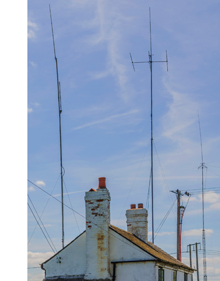
Ham Radio Towers

Source: Adrian J. Adams Esq.
One of the purposes of an association is to protect property values. In addition to maintenance, HOAs 
regulate what people do with their property, i.e., no boats parked on the front lawn, paint your house, don’t install large unsightly antennas, etc.
Bills in Congress. Unfortunately, there are bills in congress that would eliminate HOA restrictions on ham radio masts and towers.
Negative ImpactRobert Browning, a radio enthusiast with a General Class Amateur Radio license, examined the impact of the bills and believes voiding HOA restrictions would be detrimental to communities. He made the following observations:
  1. Electronics Interference. Ham operators can use either small towers or large ones. Small towers are less unsightly but require higher wattage to be effective. This can interfere with the electronics of neighbors up to several hundred feet away.

  2. Property Values. If the ham operator installs a large tower so as to avoid interfering with his neighbor’s electronics, he creates an eyesore. The bigger the tower, the more unsightly it becomes, both from size and from all the cables needed for stability. The bigger the eyesore, the more it drives down property values.
  3. Safety Issues. Large towers, if not properly secured, can topple onto neighboring properties causing injuries and damage. Safety concerns by neighbors would further depress property values.
Public Interest. Some believe the public interest requires radio towers in HOAs for emergencies. Mr. Browning argues to the contrary. He points out that emergencies (wildfires, earthquakes, hurricanes, tornadoes) require ham operator to report to a particular location. Licensees who volunteer have ready-to-go radio kits called “go-bags” with portable radios, batteries, generators, portable masts and antennas. Thus, there is no need for radio towers in homeowners associations.
Needless Burden. Mr. Browning further observed that other emergency responders do not burden their neighbors with the tools of their trades. For example, paramedics and EMTs do not drive ambulances home, nor do police officers or tow truck drivers. In conclusion, the legislation is unduly burdensome and produces no true public benefit. To read Robert Browning’s report in its entirety, see his White Paper.
RECOMMENDATION: To protect their property values, readers should urge federal legislators to oppose ham radio legislation. CAI has made it easy to send an email to legislators by providing a link with prepared language. It takes only seconds to send. Click here to send an email.

SaveSave